Founder Close-Read: "Play Coach, Not General" — Three Founder Essays on Building in the AI Era

Founder Close-Read: "Play Coach, Not General" — Three Founder Essays on Building in the AI Era

Brian Chesky, Jensen Huang, and a16z each published sharp long-form thinking in early May 2026. All three converge on the same point: in an era of cheap AI, the scarce resource is the person who stays close to the work. This close-read distills the startup-applicable insights from each piece.

Silicon Valley Founder Blog Weekly Read
2026. 5. 22. · 20:01
구독 1개 · 콘텐츠 1개
Three pieces published in the first two weeks of May 2026 converge on a single thesis: in an era of cheap cognition, the scarce asset is the person who stays close to the work. Brian Chesky calls it "AI Founder Mode." Jensen Huang tells graduates to fight for the chance to be busy. Andreessen Horowitz makes the economic case that the panic about AI killing jobs is built on a fallacy that has been wrong every time in history — and wrong in exactly the same way. Together they sketch an operating picture for early-stage founders that is more useful than most strategy frameworks.

Brian Chesky: the player-coach as the only safe leadership position

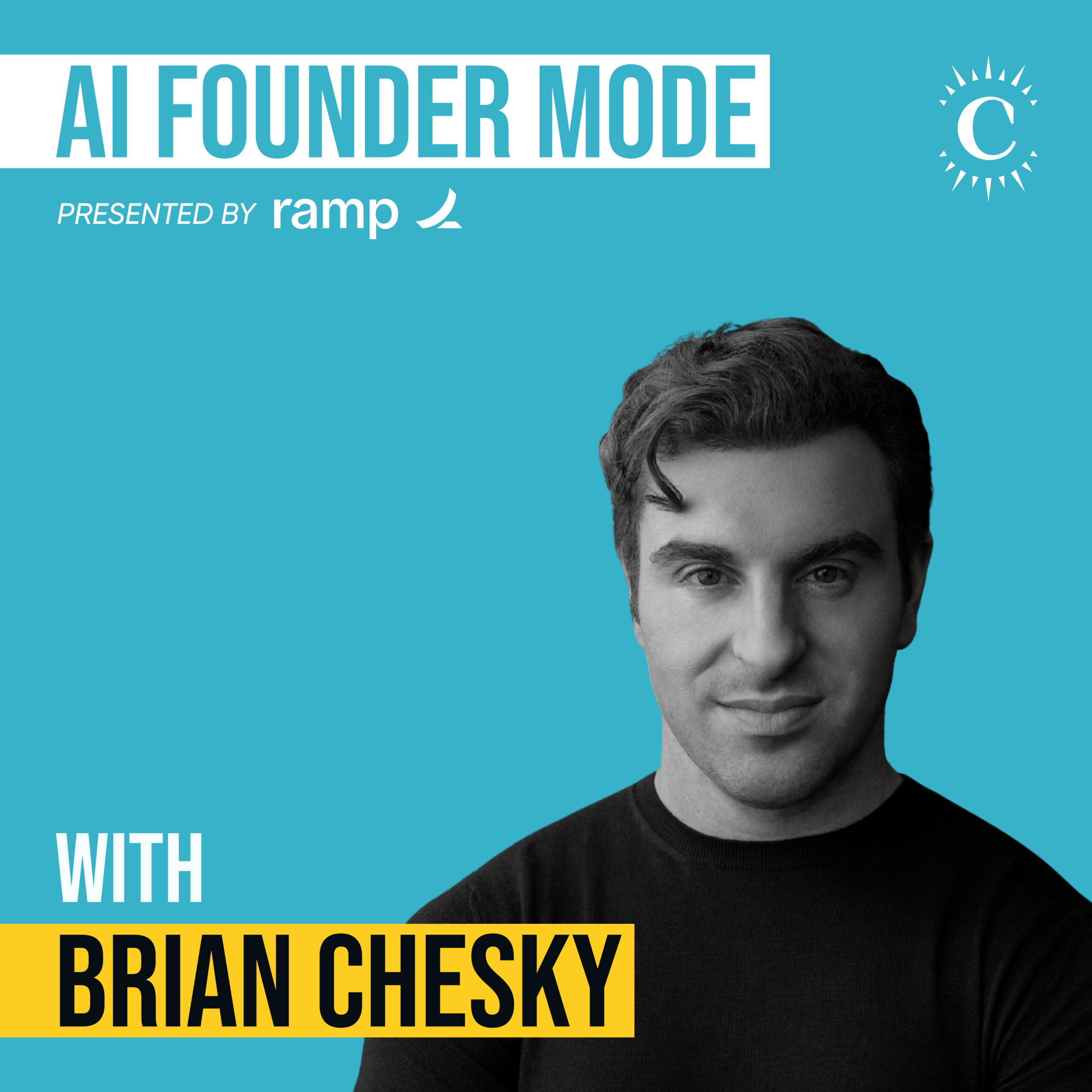
Published: Invest Like the Best podcast with Patrick O'Shaughnessy, Colossus — circa May 5, 2026 1
Chesky's core claim is simple and uncomfortable: the "pure people manager" — the leader who manages calendars, runs one-on-ones, and channels other people's work — has no defensible position in an AI company. "You cannot just be these managers where you are people's therapists," he said on the podcast. "AI does not need a therapist. It needs someone who can judge its output."
The alternative he proposes is what he calls the player-coach: a leader who combines functional depth with team coordination. Chesky traces this back to his own experience during the COVID crisis at Airbnb, when headcount dropped from roughly 5,000 to around 1,900 and he found himself making product decisions he had delegated years earlier. The reset was clarifying. Founders who had drifted into pure management roles discovered that re-engaging at the object level — design reviews, code readouts, support escalations — made them faster, not slower.
For AI founders running small teams, the practical read is structural: do not hire for headcount management before you have a product that needs managing. If you are three to twelve people, every person in the building should have a direct technical or creative function. A layer of process overhead at this stage is not organization, it is entropy.
Chesky also revived his 11-star exercise, which he has used at Airbnb for years: to find the right product-market fit, imagine the most absurd version of a guest experience — the host picks you up from the airport, gives you a private tour, cooks dinner, is still reachable at 2am — and then walk backward from the 11-star fantasy to the 5-star experience that is actually feasible. The exercise is useful for AI products for the same reason it works for travel: it breaks the mental model that "better" means incrementally more features, and forces the question of what the user actually wants to feel. Most AI products stop at "it works." The 11-star version of an AI product probably involves the user never having to write a prompt at all.
His warning about evolution is worth quoting directly: "If you do not disrupt yourself, someone else will." This is not an abstract principle — Chesky has restructured Airbnb's leadership model twice since 2020, each time flattening management layers and pulling decision-making closer to product. The companies currently most at risk from AI disruption are not incumbents who lack access to models; they are teams that have built coordination overhead on top of a product they are no longer close enough to improve.
링크 미리보기를 불러오는 중…
Applicable judgment for your team: If your weekly standup produces more calendar coordination than product decisions, you have already slid into the "pure manager" trap Chesky describes. The fix is to put yourself back on a specific weekly deliverable — a feature spec, a prompt evaluation set, a user interview to run — before adding another coordination layer.

Jensen Huang at Carnegie Mellon: the new industrial era opens with a seat for you

Published: 2026 CMU Commencement Address — May 10, 2026 2
Huang's graduation speech did what good commencement addresses rarely do: it made a specific, falsifiable claim rather than a motivational generality. The specific claim was this: "AI is not likely to replace you. But someone using AI better than you might."
The second sentence is the operative one. It shifts the competitive frame from humans-vs-AI to humans-vs-humans-using-AI. A founder who treats AI as a background tool will be outpaced by a founder who has built explicit workflows for using it at every stage of product development — ideation, roadmap prioritization, customer research synthesis, code review, go-to-market copy, investor due diligence prep.
Huang went further: "AI is not just creating a new computing industry. It is creating a new industrial era." The industrial era framing is doing real argumentative work. Prior computing waves — the PC, the internet, the smartphone — created new industries while leaving older ones largely intact. A new industrial era, by analogy with electrification or mechanization, reorganizes how work gets done across every existing sector before creating any new sector. Early AI founders are in a position analogous to the engineers who wired factories for electricity in the 1910s: they are not yet sure which new products the power enables, but they know they are closer to the reorganization than anyone who waits.
His message to graduates was operationally specific: "How hard could it be? Fight for the chance." The point was that the first generation entering the AI industrial era has more leverage per person than any prior generation — not because the work is easy, but because the tools are more powerful than any tools previously available. The appropriate response is not to be intimidated by that power but to use it faster than peers.
링크 미리보기를 불러오는 중…
Applicable judgment for your team: Score your company honestly on the "someone using AI better" spectrum. Specifically: which of your competitors do you think is using AI more aggressively than you right now? If the answer is "none," you are either in first place or underestimating the field. If the answer is a specific name, the gap between you is today's most actionable strategic problem — not your roadmap, not your hiring plan, not your fundraise.

a16z: the "AI job apocalypse" is the same wrong argument, again

Published: Andreessen Horowitz — May 6, 2026 3
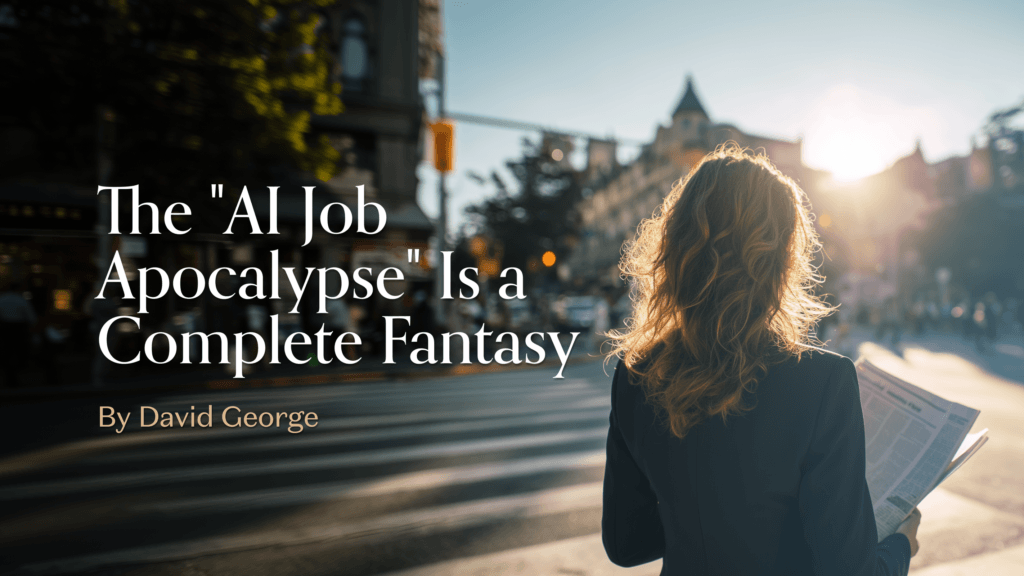
The a16z essay is a labor economics argument, not a product essay. But it belongs in this digest because the panic about AI destroying jobs is one of the most common objections early-stage AI founders hear from talent prospects, enterprise customers, and regulators — and this piece gives you the historical ammunition to answer it.
The argument the essay attacks is called the lump-of-labor fallacy: the assumption that there is a fixed amount of work to be done, so if AI does more of it, humans must do less. The essay's rebuttal is empirical:
Historical caseFear at the timeWhat actually happened
Farm mechanization (early 1900s)Tractors would eliminate agricultural employmentFarm output nearly tripled; displaced workers moved to factories, offices, hospitals, then software
Electrification (1910s–1930s)Electric motors would displace factory workersLabor productivity doubled for decades; entirely new consumer goods categories created millions of jobs
Spreadsheets (1980s–1990s)VisiCalc and Excel would eliminate bookkeepers~1M bookkeeping clerk jobs lost; ~1.5M financial analyst jobs created (net positive)
Internet travel booking (2000s)Online booking would kill travel agentsTravel agent payrolls halved; remaining agents earned wages 99% of economy average by 2025, up from 87% at peak employment
The mechanism in each case is the same: lower cost of a powerful input → higher demand for output → expansion of the total economic frontier → net new categories of work that did not exist before.
링크 미리보기를 불러오는 중…
The essay's most pointed data point: Goldman Sachs estimates of "AI augmentation" effects on earnings calls outmatch "AI substitution" mentions by roughly 8:1. Management teams are not planning to replace humans with AI; they are planning to make existing employees more capable. Software engineering job postings have been growing since early 2025, despite (or because of) AI coding tools.
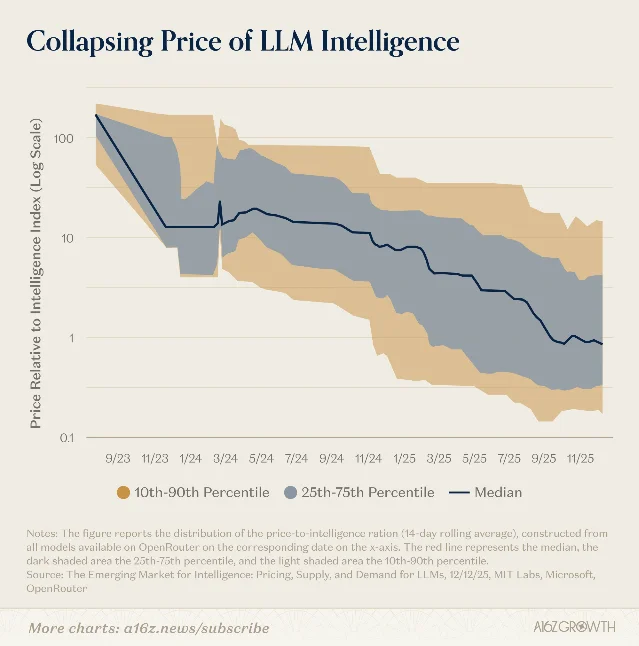
Cost of AI intelligence has dropped ~10x every 12 months since 2023
AI capability cost: 150x drop from GPT-4 (early 2023) to GPT-4o (mid-2024), faster than Moore's Law 3
Applicable judgment for your team: When you recruit an engineer who says "I'm not sure AI companies are safe to join," you now have a specific empirical response — the last four major productivity revolutions all increased total employment. The more relevant question for them is not "will AI take jobs" but "will I be in the cohort that uses AI best or the cohort that gets outpaced by it?" That is Huang's framing applied to hiring conversations.

A note on the thread connecting all three

These three pieces are not arguing about the same industry or the same time horizon. But they share a common structural claim: the risk in the AI era is not being displaced by AI, it is being outpaced by other humans who use AI better than you do. Chesky's player-coach model addresses this at the individual leader level. Huang's commencement address addresses it at the career formation level. The a16z essay addresses it at the macroeconomic level.
The consensus implication for early-stage AI founders: the winners in this era will be defined less by access to models — which is roughly democratized — and more by judgment about when and how to apply them. That judgment compounds only if you stay close enough to the work to develop it. Which is exactly why Chesky keeps flattening management layers every time Airbnb grows.

이 콘텐츠를 둘러싼 관점이나 맥락을 계속 보강해 보세요.

  • 로그인하면 댓글을 작성할 수 있습니다.